Monday, April 15, 2013

April 2

I spent the day in the lab, making regrind of P. ostreatus for my current experiment.  It turns out the P. citrinopileatus  (golden) didn't grow well enough in the grain bag to continue with the experiment.  We have to now order the two oyster species, the pink and golden oysters.  The two mushroom species probably failed to grow properly due to the way the strains were packaged.  Hopefully our next order will work.
Also, we decided that we wouldn't perform the experiment I designed dealing with the black mold and mycoremediation.  With the mold, it is possible to contaminate the lab, even using proper aseptic tools.  We don't want to risk that, and the main idea was to gain experience in designing an experiment.  I also learned a lot from this experiment I designed.  Not only how to design experiments but how to research information effectively, on top of learning about other peoples' research.  I found a lot of unexpected information that improved my understanding of mushrooms in the bigger health picture.  
I really liked this method of learning, so I am going to continue doing outside research to perform a smaller experiment.  I'm interested in maybe reading up more about hormones and more structural components of mushrooms.

Beneath is also a picture of a block Sarah gave me to grow.  This block has to examples of contamination on it.  The obvious one being in the very center is mold.  At the far right corner you see Rhizopus which is a type of parasitic fungi.  It can be deceiving at first because it is white and fluffy like regular mycelium.  However, as it grows you begin to see dark specks in the white, fluffiness.  
Surprisingly, this block did produce some fruiting bodies, but their wet weights were small.

Tuesday, March 26, 2013

March 12, Inoculation Day

Today, I spent most of the time inoculating grain bags with the mushrooms for the experiment with different oyster species.  Sadly, we are not going to be able to use Pleurotus djamor because the mushroom did not spawn enough on the plate.  You can see this on the picture below.  The very left plate is the normal Pleurotus ostreatus that we have been using for the other experiments.  In the middle is Pleurotus citrinopileatus which did not spread as much as P. ostreatus but enough for us to continue the experiment. The very right plate is P. djamor which clearly did not grow on the plate.
Inoculating the grain bags was another good review of aseptic techniques.  Furthermore, since I had only inoculated grain bags with Courtney before, it was a good experience to be doing it with Sarah.  I was able to see more ways of handling contamination.  This is good for me because it allows me to pick and choose methods that work best for me.
Over break, I am to finish the conclusion for the light vs. dark experiment.  The average of the total wet weight (the weight from the first flush added to the second flush) was greater for the light set than the dark set, not as we had predicted.  For both sets, the second flush yielded smaller oysters.  I don't believe much error came from contamination, as only three blocks were contaminated and two of those were from the light set.


Tuesday, March 12, 2013

March 5, Bio-future!


Today, I got to sit in on a meeting with Courtney for the Bio-future group at Ecovative.  This is just a small group of people working on projects that are not meant to be developed into products in the near future, but for further down the road.  The purpose of the meeting was for a few members part of this group to share what they were working on.  It was difficult to completely understand everything discussed, but as someone told me at the meeting, it only matters that I understood 10% of the material.  So long as I learn something new.  Among the topics included creating a new material for ice packs, something about a car engine, crystallization in the mushroom, and strength of mycelium blocks.

The project with the different oyster mushroom species didn't need any work this week.  We just let the plates containing the mushrooms grow, so that we can use them to innoculate grain bags next week.
I have been researching other mushrooms to use for the antibacterial experiment I want to do.  The three I will pick from are Hericium erinacus (Lion's Mane, Bearded Tooth Mushroom), Ganoderma lucidem (Lingzhi Mushroom), and Trametes versicolor (Turkey Tail).  All three have really amazing healing properties.

File:Ganoderma lucidum 01.jpg
The Lingzhi mushroom has been traditionally used in Chinese medicine.  It has anti-tumor and immunotherapeutic (modifying an immune response--whether by making it stronger, restraining it, or instigating it--to treat a disease) properties.  I think this mushroom looks disgusting, but it is healthy!
http://commons.wikimedia.org/wiki/File:Ganoderma_lucidum_01.jpg
File:Stumpfungus.jpg
This is the Turkey Tail mushroom.  Its very fitting.  This mushroom contains something called Polysaccharide K (PSK) which can boost the immune system and be used to treat cancer.  PSK has shown to be beneficial in treating gastric, esophaegal, colorectal, breast and lung cancer.  This too is a Chinese medicinal mushroom.
http://en.wikipedia.org/wiki/File:Stumpfungus.jpg
I think this mushroom is a winner for my project.  The Lion's Mane (also called the Bearded Tooth) mushroom has crazy properties!  It is also a traditional Chinese medicine and has been proven to have antioxidant effects.  It can also be used to treat gastric ulcers.  Currently their are lots of studies going into the anti-dimentia compounds of this specific mushroom.  This mushroom has been determined to stimulate animal nerve cell growth.  In my research I found a paper that experimented with this on rats.  Here is a link if you are interested: http://www.dl.begellhouse.com/pt/journals/708ae68d64b17c52,03ea8c440cfbb276,23c2fd3840f4e0c9.html
This is also an edible mushroom.  I believe I've eaten myself at some point.  I've known it as the Monkey Head mushroom.  Pretty yummy :)

http://www.mykoweb.com/CAF/photos/Hericium_erinaceus(nw-01).jpg

Monday, March 4, 2013

February 26, Solo Work!


I am still figuring out specific but important technicalities to my experiment.  As part of my method and procedure, I am going to dehydrate the fruiting body.  However with C. cinereus, once they release their spores, they turn goop and obviously it becomes impossible to dehydrate them.  So I am looking for another species of mushroom I can test on.
Despite still figuring out the small details, I was able to begin collecting A. niger, the black mold, by placing agar plates in contaminated areas.  This might not be the most efficient way of getting the mold, but it is convenient with the tools we have.  The plates will not be purely A. niger.  While working on this project, I am also starting another experiment with Sarah for her oyster mushroom kit experiments.  This time, we are looking into different species of oyster mushrooms and seeing how they can grow on the grow-it-yourself kits.  Along with Pleurotus ostreatus I will be testing Pleurotus djamor,and Pleurotus citrinopileatus.  They are both edible mushrooms.


Pleurotus citrinopileatus


Pleurotus djamor
                                   

Other than discussing upcoming projects, I spent the majority of this time helping prepare substrate for Caroline's straw experiment.  I was let loose to make the substrate by myself and boy was it intimidating at first.  I made substrate once or twice with Courtney and Sarah, so I had to recall the procedure.  It was a good thing that making substrate does not require aseptic techniques.  Straw was everywhere but after making a bag or two though, I got the hang of it and now I can confidently make substrate bags myself.

Sunday, February 24, 2013

February 19

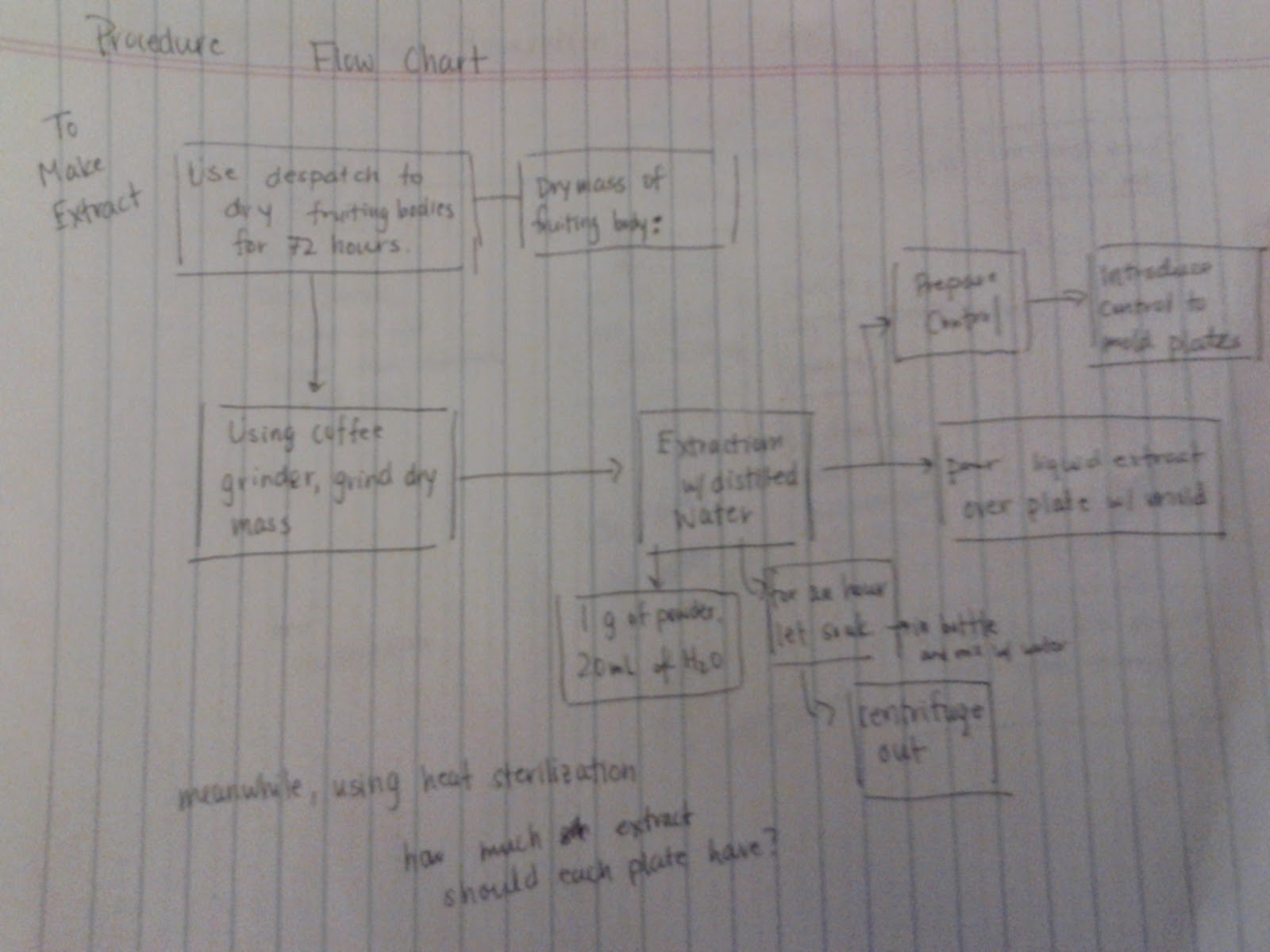
One of my flow charts
Today, I was supposed to work with Sarah, but she was at an appointment.  So, I learned how to sort corn substrate.  The substrate is sorted by size, and it was done so by a vibrating machine of sorts.  There were holes of different sizes in the machine so that when the substrate passed by, the different sized particles would fall through the holes accordingly.

After sorting corn, I went to work on designing the procedure of my experiment.  From my research, I knew the general outline that I had to follow, but the details were vague.  I didn't know what equipment was available to me, and since I want to work with a pathogen, how was I going to do this without contaminating the whole lab?  Courtney clarified many of these details and suggested that I utilize a flow chart to help organize my thoughts and details.  The flow chart especially helps with figuring out the timing.  What else could I be doing when the mushrooms are drying or how long does it take to centrifuge?  Since I have limited time, this is crucial.

My final experiment will be comparing the antibacterial properties of Pleurotus ostreatus and Coprinus cinereus on Aspergiillus niger.  

My first DoE, the one looking to compare light and dark reactions came out with data.  Based off of the data for the fruiting bodies wet weight, the light mushrooms had the greatest average wet weight.  This is not what we predicted but it is helpful to know nonetheless.

Tuesday, February 19, 2013

February 12, C. cinereus

I worked with Courtney this time, and we spent time transferring plates (the first thing I did way back in October).  It was a good review of lab skills, especially involving contamination!  I had to remember not to open the pipette outside of the hood or let my hand pass over open containers (even if it is gloved and sprayed with alcohol).
I also made observations for the DoE on lighting regimes.  Here are some of the things I saw:

LIGHT SET
All 8 sets are fruiting
5 are in the beginning stages of fruiting
1 in the medium stage
1 in the middle/end stage, not quite ready for harvest
all 8 blocks fully colonized
DARK SET
All 8 sets are fruiting
Five are still in the early stages of fruiting
Two in the middle stages of fruiting
One nearly ready to be harvested

Next week the mushrooms should be ready to harvest.  Then I'll be able to weigh them for my data and write the rest of my DoE.

For my final experiment, I think I'm going to simplify my experiment by just comparing the antimicrobial effects of two mushrooms for the mold Aspergiillus niger.  One of these mushrooms for sure will be oyster mushrooms as we have a lot of them coming from Sarah's experiments for the self-growing mushroom product she is helping to develop.  The other mushroom might be one called Coprinus cinereus, also called the gray shag.  It is an edible mushroom.  This mushrooms short life cycle (two weeks in a lab) and easy cultivation makes it a useful organism to study and analyze genetics and molecular studies.  It has also been proven that this mushroom has antimicrobial properties against A. niger.


C. cinereus before spores are released.
C. cinereus after spores are released.

February 5!

Today was spent working with Sarah.  I helped out with preparing regrind and rehydrating blocks for other experiments apart of Sarah's coffee grind product for Back to the Roots Company.
My own experiment on lighting regimes for oyster mushrooms has come a long way.  I believe in a few weeks we will be able to harvest them.  Here are some pictures that summarize my experiment.


These are all part of the dark treatment.  A few blocks did not colonize, at least on the outside, such as the one in the middle.  However they did still grow mushrooms such as the one below.  From observation, the dark treatment blocks that did colonize seemed to colonize more. 

Dark Treatment, the largest of the oysters.  To answer a question Peggy asked during our meeting, we know when to harvest to mushrooms when they begin to produce spores.  This you can see, and it looks like fine dust.  Then we'll cut and weigh the mushrooms.


Dark treatment.  These mushrooms are nice.  

A light treatment.
These are baby mushrooms growing on the sides of the block that has no hole cut in it.  Since there is no air hole, these mushrooms will not last long, but as of this picture, they are trying to grow along the edge of the ziploc bag and up.
  
For my next experiment I'm still looking for possibilities.  Since this is really the first experiment I am designing myself, I don't want to complicate it too much.  Still thinking along the lines of mycofiltration, but I'm looking up pathogens.  Many of the pathogens in my book however were really dangerous, they trigger tuberculosis and cholera, but there was one that I might really be able to work with.  It is called Aspergillus niger.  This microbe causes black molds which is commonly found everywhere in the world.  Aspergillus niger has proven to be helpful in biotechnology and waste treatment but it can be harmful to human health if not treated carefully.  My mentors said they can also easily obtain this pathogen.